
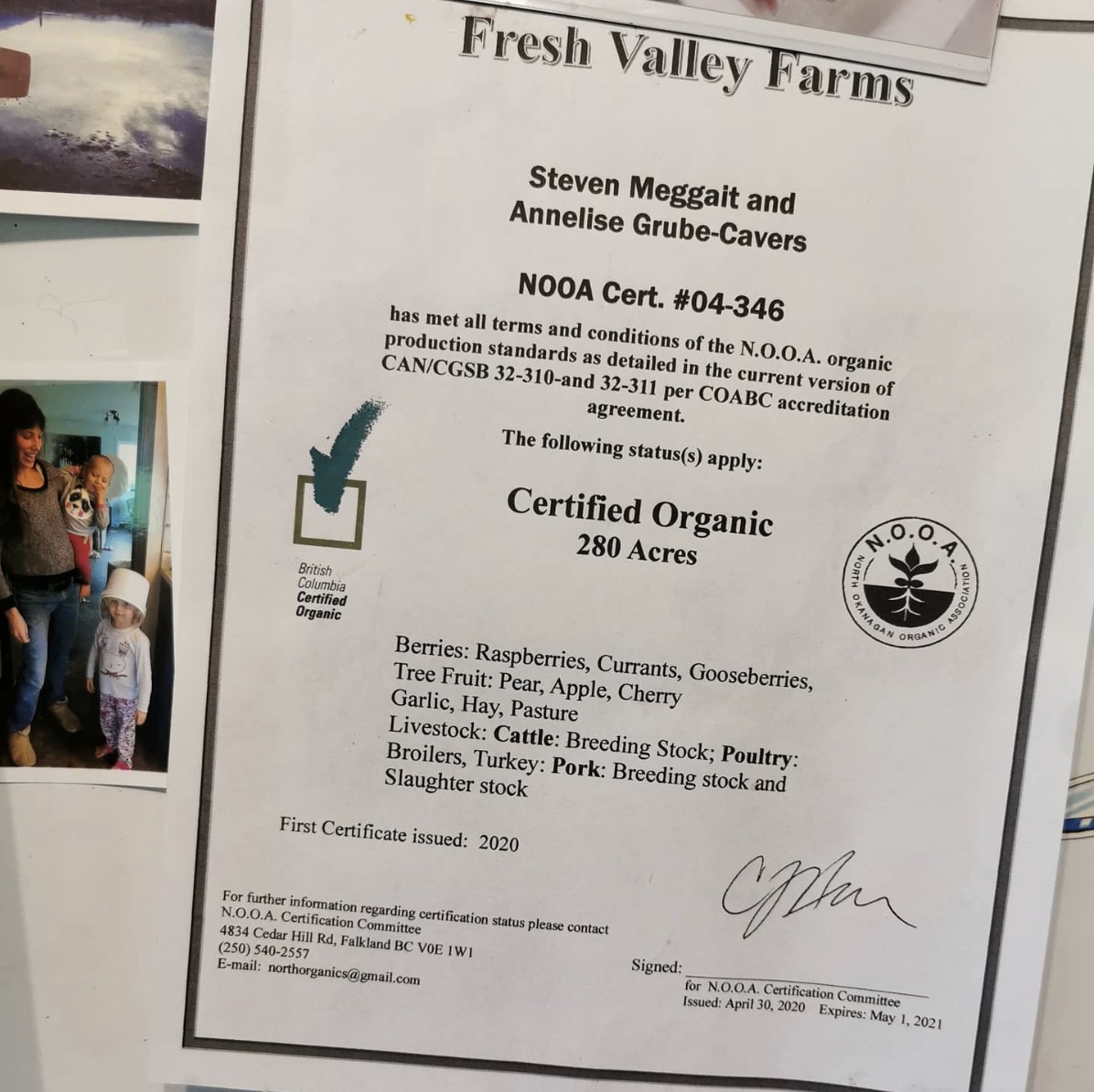
Fresh Valley Farms is Certified Organic under the North Okanagan Organic Association Certificate #04-346
Organic certification is not a marketing label for us. It is a regulated, inspected system that shapes how we farm every day.
Fresh Valley Farms is Certified Organic under the North Okanagan Organic Association (Cert #04-346). Our certification is verified by a third-party certifier and renewed through annual inspections and record reviews.
This certification covers 280 acres of land and includes our pastures, hay fields, crops, and livestock. It forms the foundation for everything we produce on the farm.

What Certified Organic means
Certified Organic farming follows Canada’s national organic standards. These standards are written into law and enforced through inspections, documentation, and ongoing oversight.
For our farm, organic certification means:
- We do not use synthetic fertilizers, herbicides, or pesticides on our land.
- We do not use genetically modified organisms.
- We manage soil health through biological systems rather than chemical inputs.
- We raise animals with outdoor access and space to express natural behaviors.
- We keep detailed records that are reviewed every year by an independent body.
Organic certification is about systems, not shortcuts. It requires planning, consistency, and transparency.
What is included in our certification
Our Certified Organic status includes:
- Pasture and hay land used to feed livestock
- Tree fruit and berries grown on the farm
- Garlic and field pasture crops
- Livestock, including cattle, poultry, and pigs
Each area of the farm is inspected and documented as part of the certification process. Nothing is assumed or grandfathered in.

The four principles of organic agriculture
At Fresh Valley Farms, certified organic farming is grounded in what IFOAM – Organics International calls The Four Principles of Organic Agriculture: Health, Ecology, Fairness, and Care. IFOAM describes these principles as “the roots from which organic agriculture grows and develops.” It also explains that they are interconnected ethical principles that guide the organic movement’s positions, programs, and standards.
These four principles help explain what organic farming is meant to do. They show that organic agriculture is not just about avoiding certain products or inputs. It is about farming in a way that supports living systems, respects natural limits, and protects the future of the land. At Fresh Valley Farms, these principles shape how we care for our soil, our pastures, our animals, and the food we produce.

Health
IFOAM’s Principle of Health says that “organic agriculture should sustain and enhance the health of soil, plant, animal, human and planet as one and indivisible.” That idea is at the heart of how we understand farming. Health is not one separate part of the system. It runs through the whole farm.
For us, this starts with the soil. Healthy soil supports healthy pasture. Healthy pasture supports healthy animals. Healthy animals help produce healthy food. We work to build soil structure, support soil biology, and keep the land productive through careful management rather than short-term fixes. We want our farm to be alive, resilient, and strong from the ground up.
This principle also reminds us that farm health is connected to human health. The choices made on a farm affect the food people bring home, the condition of the land, and the long-term strength of the local food system. Organic farming calls us to think in wholes, not fragments. That means caring for the entire chain, from the microorganisms in the soil to the families who trust us with their food.

Ecology
IFOAM’s Principle of Ecology says that “organic agriculture should be based on living ecological systems and cycles, work with them, emulate them and help sustain them.” In simple terms, organic farming is meant to work with nature, not against it.
At Fresh Valley Farms, that means paying close attention to the natural systems that make farming possible. Soil life, grasses, rainfall, livestock, insects, water movement, and seasonal change all work together. Good farming depends on understanding those connections and managing them with care.
This principle shows up in how we manage pasture and grazing. Land needs rest as well as use. Grasses need time to recover. Healthy root systems matter. Water needs to soak in and stay in the soil. A living pasture is not just feed for animals. It is part of a larger ecosystem that supports the whole farm.
Ecology also means respecting diversity. A healthy farm system is stronger when it has many living parts working together. Organic farming asks us to support that richness instead of simplifying the land until it becomes weak and dependent. We want our farm to function as a living system that can stay productive over time.
Fairness
IFOAM’s Principle of Fairness says that “organic agriculture should build on relationships that ensure fairness with regard to the common environment and life opportunities.” This principle makes clear that organic farming is not only about biology. It is also about relationships and responsibility.
At Fresh Valley Farms, fairness includes how we relate to the land, the animals, our customers, our employees, and the wider community. We believe animals deserve attentive care, humane handling, good feed, clean water, and conditions that respect their nature. We believe the land deserves stewardship, not depletion. We believe customers deserve food raised with honesty and integrity.
Fairness also means recognizing that farming decisions have effects beyond the farm gate. When land is overworked, animals are treated poorly, or short-term gain comes before long-term stewardship, the costs do not disappear. They are passed on to others. Organic farming pushes back against that way of thinking.
This principle matters to us because it keeps farming tied to ethics. It asks not only whether something is efficient, but whether it is right. It reminds us that a good farm must serve more than production alone.

Care
IFOAM’s Principle of Care says that “organic agriculture should be managed in a precautionary and responsible manner to protect the health and well-being of current and future generations and the environment.” This principle speaks to humility, judgment, and long-term thinking.
On a working farm, care means making thoughtful choices even when no one is watching. It means paying attention to the long-term effects of today’s decisions. It means being cautious about actions that could damage the soil, the animals, the environment, or the future of the farm.
At Fresh Valley Farms, care shows up in daily management. It means watching conditions closely. It means adjusting when the land or animals need something different. It means treating organic farming as an active responsibility, not a checklist. We want to farm in a way that protects what has been entrusted to us.
This principle also reminds us that farming always involves uncertainty. Weather shifts. Seasons change. Living systems are complex. Care means responding with responsibility, patience, and respect for limits. It means choosing stewardship over shortcuts.
How organic farming protects the land
Organic standards are designed to protect soil, water, and ecosystems over the long term. By avoiding synthetic inputs, we support soil biology instead of suppressing it. Healthy soils hold more water, store more carbon, and grow more resilient plants. These living systems are the backbone of regenerative agriculture.
Organic certification creates the conditions that allow us to rotate livestock, build fertility naturally, and respond to the land rather than force outcomes.

Organic and animal care
Organic livestock standards prioritize animal health through management, not medication.
For our animals, this means:
- Access to pasture and outdoor space
- Organic or GMO-free feed, depending on species and availability
- Low-stress handling and movement
- Preventive care based on nutrition, space, and cleanliness
Animals are not treated as units of production. Their health is directly connected to the health of the land they live on.
You can explore how this shows up in our food through our 100% grass-fed and finished beef, pork, chicken, and eggs.

Annual inspections and accountability
Organic certification is not permanent. It must be renewed every year.
Inspectors review:
- Land management practices
- Livestock records
- Feed sources
- Input purchases
- Sales and labeling
- Traceability from field to product
This process ensures that our organic claims are verified, documented, and accountable. If standards are not met, certification can be suspended or revoked. That accountability is what gives the organic label meaning.

When we became certified
Fresh Valley Farms received its first Certified Organic certificate in 2020. That milestone followed years of transitional management and planning. The land had been managed without synthetic pesticides for several decades prior to the transitional organic period.
Certification marked a commitment to farming within a regulated system that aligns with our values and long-term vision for the land.

Organic as a foundation, not the finish line
Certified Organic is our baseline, not our endpoint.
Organic standards create the minimum conditions required for ecological farming to function. From there, we build toward regenerative agriculture practices that focus on:
- Improving soil structure and fertility
- Increasing biodiversity on the farm
- Managing livestock as part of ecological systems
- Reducing reliance on external inputs
- Supporting long-term resilience over short-term yield
Nature is complex, and no farm can fully recreate natural ecosystems. Our goal is not perfection. It is stewardship.
Organic certification gives us the structure and accountability to do this work responsibly.

Why this matters to our customers
Choosing Certified Organic food supports a system that values transparency, soil health, animal welfare, and long-term land stewardship.
When you buy from Fresh Valley Farms, you are choosing food that is:
- Produced without synthetic chemicals
- Raised within a regulated and inspected system
- Grown with respect for ecological limits
- Accountable to independent certification
Organic certification helps ensure that the choices we make on the farm align with the values you bring to your table.